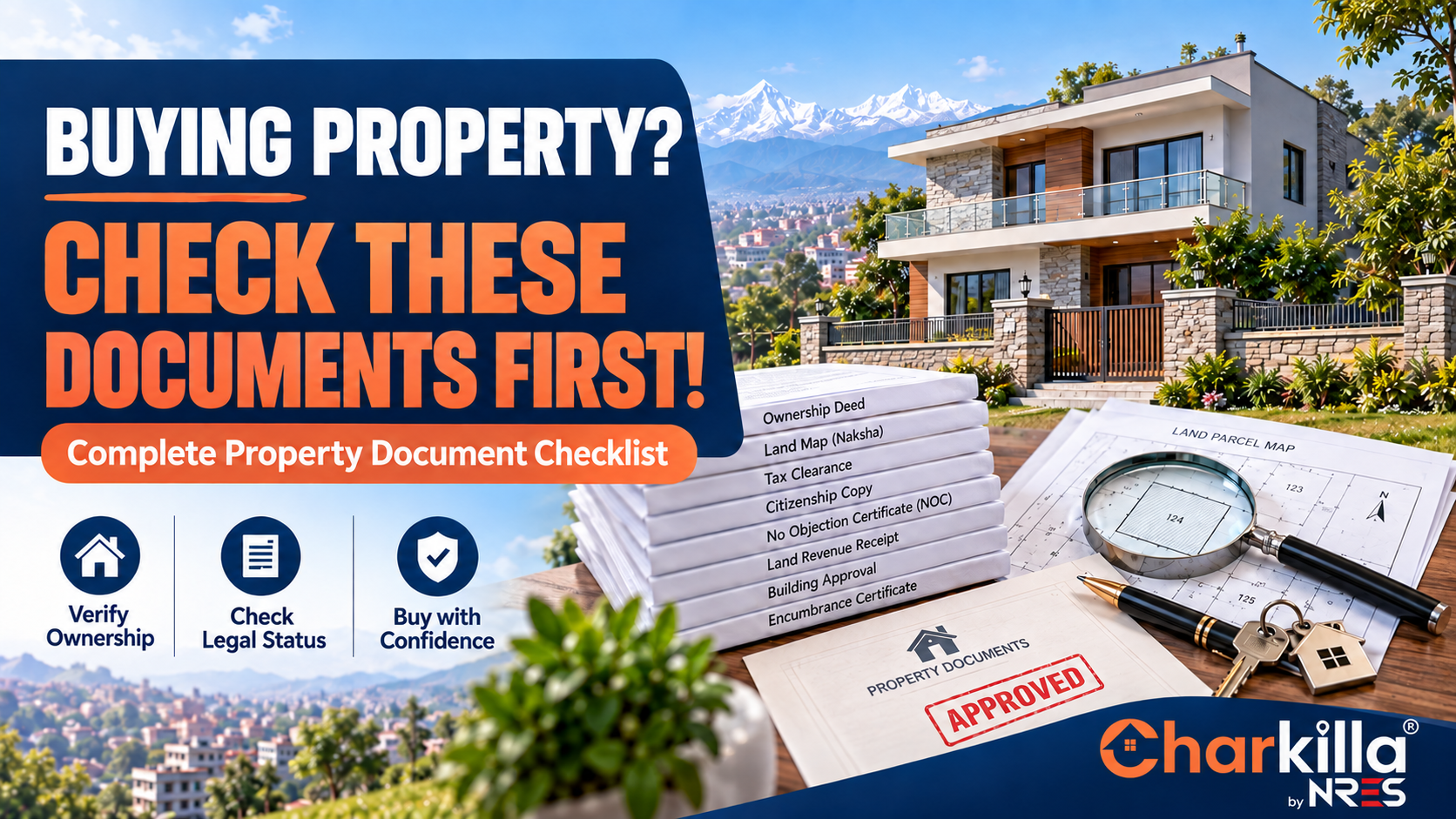
How Can I Verify the Legal Ownership of Land or a House in Nepal?
Before buying land or a house in Nepal, verifying its legal ownership is one of the most important steps. A seller showing you a property, a photocopy of a Lalpurja, or a tax receipt does not automatically prove that the property is legally transferable.
To verify property ownership in Nepal, buyers should compare the seller’s identity with the original Land Ownership Certificate, confirm the records at the relevant Land Revenue Office, examine the cadastral documents, check for mortgages or legal restrictions, and investigate possible family or court disputes.
This guide explains how to verify the legal ownership of land or a house in Nepal before making an advance payment or signing a Bayana Agreement.
Quick Answer: How Do You Verify Property Ownership in Nepal?
You can verify the legal ownership of a property by checking:
Original Land Ownership Certificate (Lalpurja)
Seller’s citizenship or company documents
Current ownership record at the Land Revenue Office
Cadastral map and field book from the Survey Office
Latest land revenue and municipal tax receipts
Mortgage, रोक्का, court case, or transfer restriction
Previous ownership transfer documents
Family inheritance or partition documents
Legal road access and property boundaries
Building map approval and completion documents
Never depend only on documents provided by the seller. Important records should be independently verified through the relevant government offices and qualified professionals.
1. Check the Original Land Ownership Certificate (Lalpurja)
The Land Ownership Certificate, commonly known as the Lalpurja, is the primary document showing the registered landowner.
Check the original document and confirm:
Full name of the registered owner
Citizenship details
District, municipality and ward number
Sheet number
Kitta number
Total land area
Type or classification of land
Remarks, restrictions or recorded interests
Compare these details with the seller’s original citizenship certificate. Even a minor difference in the owner’s name, address, Kitta number, or land area should be investigated before proceeding.
A photocopy or digital image of a Lalpurja should not be accepted as final proof of ownership.
2. Verify the Seller’s Identity
The individual selling the property should be the same person recorded as the legal owner.
Check the seller’s:
Original citizenship certificate
Recent photograph
Signature
Permanent address
Father’s or spouse’s name, where relevant
Contact information
If the registered owner is not personally present, find out why another person is handling the transaction.
When a representative is selling through a Power of Attorney, verify that the document is valid, properly authenticated, and specifically authorizes the representative to sell and transfer that particular property.
3. Confirm Ownership at the Land Revenue Office
The relevant Land Revenue Office, commonly called the Malpot Office, maintains the official ownership and transfer records of land.
The ownership record should be checked directly at the office responsible for the property’s location. Confirm:
Name of the current registered owner
Kitta number and land area
How the owner obtained the property
Whether the property can legally be transferred
Whether any mortgage or restriction is recorded
Whether a transfer application is already pending
Whether the property has been divided, merged, or updated
Government records should match the Lalpurja, tax receipts, cadastral map, and the property shown at the site.
4. Check for Mortgage, रोक्का or Transfer Restrictions
A person may legally own a property but still be unable to sell it immediately. The property could be mortgaged or restricted from transfer.
Confirm whether the property is subject to:
Bank or financial institution mortgage
Government रोक्का
Court-issued restriction
Family dispute
Revenue or tax-related restriction
Loan security
Pending ownership transfer
Other recorded legal claims
If the property is mortgaged, the bank’s release process and the payment arrangement must be clearly documented. Do not pay the full purchase price based only on a verbal promise that the mortgage will be cleared later.
5. Review the Previous Ownership Transfer Documents
Ask the seller to provide the document showing how they acquired the property.
This may include:
Rajinama or sale deed
Bakaspatra or gift deed
Anshabanda or partition deed
Inheritance documents
Court decision
Government allocation document
Other lawful transfer records
Reviewing the ownership history helps identify missing heirs, disputed transfers, incorrect measurements, or suspicious changes in ownership.
A complete ownership chain is especially important when the property was recently transferred or obtained through inheritance.
6. Verify Inherited or Ancestral Property Carefully
Extra care is required when buying ancestral, inherited, or jointly owned property.
Check whether:
Legal partition has been completed
All legal heirs have been identified
The seller received the property lawfully
Any family member has filed an objection
The seller has authority to sell the entire property
Consent from other owners or family members is required
Relevant death and relationship documents are available
One family member possessing the Lalpurja does not necessarily mean that no other person has a legal claim.
Obtain legal advice before buying property involving inheritance, family partition, minor heirs, or disputed succession.
7. Verify the Cadastral Map and Field Records
Ownership verification should include both legal records and cadastral records.
Check the following documents at the relevant Survey Office:
Cadastral map or Napi Naksa
Trace map
Field book
Plot register
Updated subdivision or Kitta Kat records
These documents help verify:
Exact location of the land
Shape of the plot
Official area
Four boundaries
Neighbouring Kitta numbers
Road access
Possible encroachment
Changes caused by subdivision or consolidation
Nepal’s Survey Department also operates the official Mero Kitta online service for certain cadastral services. However, online information should be combined with formal document verification, physical measurement, and professional advice.
8. Conduct a Physical Land Survey
Documents alone may not reveal the actual condition of the property.
Hire a qualified surveyor to measure the land and compare the physical site with the official cadastral map.
The survey should confirm:
Total land area
Length and width
Boundary points
Shape of the property
Location of the access road
Encroachment by neighbours
Encroachment onto public land
Structures crossing the boundary
Difference between the occupied and registered areas
Ask adjoining property owners to confirm the boundaries when appropriate. A boundary disagreement should be resolved before signing the final purchase agreement.
9. Confirm Legal Road Access
Visible road access is not always legal road access.
A property may be reached through a track that belongs to another individual, is based only on verbal permission, or is not recorded in government documents.
Verify:
Road shown on the cadastral map
Road width in official records
Ownership of the access road
Registered right of way
Local government road records
Proposed road widening
Required road setback
Access from the public road to the property
Legal road access affects the property’s usability, valuation, financing eligibility, construction approval, and resale potential.
10. Check Land Revenue and Municipal Taxes
Request the latest:
Land revenue payment receipt
Municipal property tax receipt
House and land tax receipt, where applicable
Other local government clearances
The name, Kitta number, location, and property information on the receipts should match the ownership records.
Tax receipts alone do not prove ownership, but they help confirm whether government and municipal obligations are up to date.
11. Verify House Ownership and Building Documents
When buying a house, verifying the landowner is only the first step. You must also verify whether the building was constructed legally.
Check:
Land Ownership Certificate
Municipality-approved building drawing
Building permit or Naksa Pass
Construction approval
Building completion certificate, where applicable
Property tax records
Number of approved floors
Setback compliance
Road access
Electricity and water records
Compare the approved drawing with the actual building. Unauthorized floors, extensions, boundary violations, or construction over a restricted area may create problems with bank financing, municipal approval, insurance, renovation, and resale.
12. Check Whether the Seller Is a Company
If a company owns the property, examine:
Company registration certificate
PAN or VAT certificate
Latest company records
Memorandum and Articles of Association
Board resolution approving the sale
Authority of the person signing the agreement
Company seal and authorized signatures
Tax clearance documents, where applicable
Confirm that the company is legally active and that the transaction has been properly approved.
13. Investigate Court Cases and Local Disputes
Ask a qualified legal professional to investigate whether the property is involved in a legal case or ownership dispute.
Possible risks include:
Ownership litigation
Family partition disputes
Boundary disputes
Tenant disputes
Double-sale allegations
Unpaid loan claims
Government acquisition
Public land encroachment
Guthi-related issues
Right-of-way disputes
Speak with neighbouring property owners and local representatives as part of the verification process. Local inquiries can reveal practical disputes that may not be immediately visible from the documents.
14. Confirm That the Property Can Be Used for Your Purpose
Legal ownership does not automatically mean the property is suitable for every type of development.
Before buying, check:
Land-use classification
Residential or commercial use
Plotting restrictions
Building height limitations
Required setbacks
Road standards
Heritage restrictions
Environmental restrictions
Government acquisition plans
Future infrastructure or road expansion
This is particularly important when buying land for apartments, commercial buildings, hotels, schools, warehouses, industries, or plotting projects.
15. Verify All Documents Before Paying Bayana
Do not pay a large advance merely because the seller promises to provide the documents later.
Before paying Bayana:
Verify the registered owner.
Check the original Lalpurja.
Confirm the property at the Malpot Office.
Examine the cadastral map.
Check mortgage and रोक्का status.
Verify road access and boundaries.
Review inheritance or company documents.
Conduct basic legal due diligence.
Confirm the agreed property and price in writing.
The Bayana Agreement should identify the property accurately and explain what happens if the seller cannot transfer a clear and legally marketable title.
Warning Signs Buyers Should Never Ignore
Be cautious if:
The seller refuses to show original documents.
The seller’s identity does not match the Lalpurja.
The price is unusually low without a clear reason.
The seller pressures you to pay immediately.
The property is being sold only through an informal representative.
The physical area does not match the documents.
The road is not shown in official records.
Family members object to the sale.
The property is mortgaged without a documented settlement plan.
The house does not match its approved building map.
The seller discourages independent legal verification.
Different buyers have already paid advances for the same property.
Stop the transaction and seek professional advice if any major inconsistency appears.
Can Property Ownership Be Verified Online in Nepal?
Some cadastral and land-related services are becoming available online, including services through the Survey Department’s Mero Kitta platform.
However, buyers should not depend entirely on screenshots, unofficial websites, social media posts, or documents sent through messaging applications.
Final verification may still require coordination with:
Land Revenue Office
Survey Office
Municipality or rural municipality
Bank or financial institution
Licensed surveyor
Property lawyer
Licensed real estate company
Online services are useful, but they do not replace complete property due diligence.
Why Is Professional Property Due Diligence Important?
Property ownership can involve more than one document. A Lalpurja may appear genuine while the property still has a mortgage, boundary dispute, inheritance claim, access problem, construction violation, or transfer restriction.
A professional due-diligence process helps verify:
Legal ownership
Ownership history
Seller’s authority
Mortgage and restriction status
Boundary and area
Road access
Tax status
Building approvals
Potential disputes
Transfer eligibility
The cost of verification is small compared with the financial and legal risk of purchasing a disputed property.
Frequently Asked Questions
Is Lalpurja enough to prove property ownership?
A Lalpurja is an essential ownership document, but buyers should also confirm the current record at the relevant Land Revenue Office and check mortgages, restrictions, cadastral records, taxes, boundaries, access, and possible disputes.
Can I verify land ownership using only the owner’s citizenship?
No. Citizenship confirms the seller’s identity but does not independently establish ownership. It must be matched with the Lalpurja and official land records.
How do I know whether a property is mortgaged?
Check the property record at the relevant Land Revenue Office and request supporting documents. If a bank has financed the property, coordinate with the bank regarding the mortgage-release process.
How can I verify the four boundaries of land?
Compare the Lalpurja, cadastral map, field records, and actual site. A qualified surveyor should physically measure the property and identify the boundary points.
How do I verify ownership of a house?
Verify the land ownership first. Then check the approved building map, construction permit, completion records, municipal taxes, actual floors, setbacks, and utility information.
Should I pay Bayana before completing ownership verification?
Basic ownership, mortgage, restriction, boundary, and access checks should be completed before paying a substantial Bayana. The agreement should protect the buyer if the seller cannot transfer a clear title.
Get Professional Property Verification in Nepal
Buying land or a house without proper ownership verification can lead to financial loss, delayed registration, boundary disputes, or lengthy legal problems.
CharKilla.com by NRES can assist you with:
Property ownership verification
Property due diligence
Land and house buying support
Lalpurja and document review
Cadastral map and boundary coordination
Property valuation
Site inspection
Bayana and documentation coordination
Property registration support
Bank loan assistance
Buying, selling, renting and leasing services
Visit CharKilla.com for trusted real estate information, verified property opportunities, and professional property assistance in Nepal.
CharKilla.com by NRES — Your Trusted Property Partner in Nepal.
Disclaimer: This article is for general information and SEO awareness. Property laws, office procedures, and required documents may vary according to the location, property type, and current regulations. Buyers should obtain independent verification from the relevant government offices and qualified legal professionals before making any payment or completing a transaction.